We had an early start to the day in order to catch the tourist bus into the centre of Dublin. At €2 each it’s a snip, considering that it is a good 45 minute bus ride from the Camac Valley Caravan Park into town. The journey takes you through the sprawling, leafy suburbs of Dublin. And leafy they are – Dublin boasts Europe’s largest urban green space; at over 700 Hectares, Phoenix Park is more than twice the size of New York’s Central Park.
The bus dropped us off at the top of O’Connell Street. Once a grand, residential parade, the Easter Uprising and the Irish Civil War managed to destroy quite a lot of it. Still, it makes an impressive (if a little seedy) entrance to the city, with a central pavement along the length of the road making the whole thing vaguely Parisian.
 A recent addition to the street is the Monument to Light, a stunning, 120 metre tall, stainless steel needle pointing up to the sky. It is Europe’s (and possibly the world’s) tallest sculpture. It stands on the spot once occupied by a statue of Admiral Lord Nelson, which disappeared in an explosion in 1966.
 Heading straight across the river, you get to Grafton Street, the backbone of the shopping district. What better place to stop and enjoy Second Breakfast than in Bewley’s Oriental Cafe (over to Tracey)….
Bewley’s Oriental Café on Grafton Street is known for its breakfasts, which it serves until the civilised hour of noon. Second breakfast being one of our favourite meals, we were happy to partake after the entertaining tour bus journey. Pete needed to warm up because he had insisted upon sitting in the uncovered area of the top deck and I needed to rest my eardrums after sitting beneath the speaker which had bombarded me loudly with a compilation of folky Irishness.
 The interior of Bewley’s is divided into different seating areas, possibly depending on what type of refreshment you wish to indulge in. We announced our need for the best meal of the day and were escorted through a light and airy section into a rather dark room at the rear. Perhaps the lights are low here so that the beautiful stained glass windows can be appreciated. Harry Clarke was the artist responsible for the windows, a major player in the Arts and Crafts movement in Ireland. The detail and colours are stunning: exotic birds in firey oranges and pinks, and the most vibrant lapiz blue-coloured climbing flowers.
Bewley’s roast their coffee several times a day on the premises. If only more so-called coffee shops could be so bothered. If tea is more your thing, I’m sure you will be equally spoilt. Apparently they were Ireland’s first company to import the stuff, so they will definitely know how to serve it. I’m only guessing here, but beverages are a major preoccupation of mine, it probably wouldn’t involve a teabag in a cup.
On the other hand, they lose points with us because the vegetarian version of their full Irish breakfast was simply the normal breakfast but leaving off the bacon, sausage and pudding ( like a black pudding I suppose ). A bit of imagination could be applied there to replace those things, or even come up with a unique veggie cooked breakfast that is so delicious the non-veggies will want it too. Having said that, we recovered from the let down and it was as tasty as any plate of eggs, mushrooms, tomatoes, potato farls and toast really. We just hoped that a place with a reputation for its breakfast would be leading the way.
Our waitress was so surly it was almost funny. Almost. Her face didn’t move, nor did she make eye contact with anyone or thing except her notepad. Questions were answered in a monotone. But there were chandeliers, so never mind.
Nourished with eggy goodness we were ready to hit the streets of Dublin.
T
Dublin has a huge amount to offer any visitor, and there was no way we would even scratch the surface in the two days we had. Still, there were a few things that scored high on my “hit-list” so we made a beeline for the first. It turned out that we weren’t alone in wanting to see “The Book of Kells.”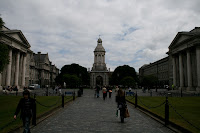 There was a huge queue of American students and old folks outside the wing of Trinity College where it is housed. Don’t these people know what the exchange rate is? Still, we waited in line and were eventually rewarded with a small but rather good exhibition of how the Book of Kells and others of its era were made and why. The book itself is in four parts – the four gospels - and two of these, along with two other contemporary books, are on display at the end of the exhibition in a small case, in a small, dark room. Considering that the book is around 1,200 years old, and considering that the monastery where it was kept was sacked by the Vikings three times and considering that the book itself was stolen and not found until a month later, without its covers and under a pile of mud, it is in an incredibly good condition. The colours are still bright and intense. Sadly (and this is a recurring theme for Dublin) no photographs were allowed. Not that it would have been possible to get close enough to take a picture. For some unfathomable reason, they have chosen to place all four books in the same cabinet, so rather than the viewers being able to spread out and enjoy each book individually, everybody is crammed around the one case, craning their necks to get a good view, and then being pushed out of the way by the next gang of tourists. All-in-all, not a great way to see what is, essentially, a giant medieval doodle.
Still, once you leave the darkened room and head upstairs, you are greeted by the staggering “Long Room” (no photographs allowed). This is much better. 65 metres long and holding miles of books, over 200,000 of them, all old and with that particular fragrance that you only get in antique bookshops. The room is lined with marble busts of the great and good of literature, philosophy, science and Ireland in general. There is also Ireland’s oldest surviving harp. Trinity College, despite Ireland’s independence, is still entitled to a free copy of every book published in the UK. This means adding about a kilometre of shelves to the stacks every year. Happily, the new stuff goes elsewhere, leaving the Long Room alone with its antiquarian texts and the smell of old paper and tourists’ cheap perfume.
 We split up. Tracey sampled the delights of Grafton Street, while I headed off to look at some art. The National Gallery houses a cracking collection of works by Irish artists, most of whom I had never heard of, along with all the usual suspects; (in no particular order) Vermeer, Titian, Monet, Gainsborough, Picasso, Rembrandt etc, but the highlight for me was “The Taking of Christ” by Caravaggio. Painted in 1602 with almost photographic detail, it is truly breathtaking. Did I mention that there were no cameras allowed? The new Millennium Wing houses modern Irish art (I would have liked to have seen more), but it is built in such a way that the doors blend into the smooth concrete walls, so it took me ages to find a way in. Once I did, I had the exhibition to myself (presumably because nobody else could get in).
We took a late lunch in Powerscourt Townhouse. It was built in 1774 as a grand mansion for Viscount Powerscourt and went through a period in the 19th century when it was used as a drapery warehouse. It was restored in the 1960’s as a very pleasant little shopping centre. The central courtyard has been covered with a glass dome and now houses an open and inviting restaurant while the rest of the building contains more cafes, jewellery shops, galleries, and antique shops. Quite charming.
 We spent the rest of the afternoon perusing the shops, something we haven’t seen much of lately, and taking in the sights. One of the obvious landmarks in the city is the River Liffey. And crossing it (along with many others) is the Ha’penny Bridge. Built in 1816 by a Shropshire ironworker, John Windsor, it was originally called the Wellington Bridge. It is now “officially” called the Liffey Bridge, but it also answers to the name “Metal Bridge”. It got the name that everybody knows it by, from the half penny toll that was levied for a crossing until 1919.
After a while, it became obvious that we needed refreshment. This could only involve Guinness. Opposite the Powerscourt Townhouse is the fabulously bohemian Grogan’s Castle Lounge. It was packed with locals, and after overcoming a slight language barrier (the barmaid couldn’t understand why I was asking for a “half”), we soaked up the atmosphere along with the Guinness and just enjoyed ourselves. Sadly, there were no seats to be had, so we moved on to the Porterhouse Bar, close to the river. This is a three-floored brew-pub with a young clientele working up to a Friday night out. The good news was that there was a bitter on offer. Porterhouse TSB is a simple, straightforward bitter beer, but it was an absolute treat to taste those hops after a month without a single sniff. Finding good beer in Ireland has been like finding a cheap caravan park. There must be some out there, because there are plenty of breweries, but we haven’t found a single draught ale or even a decent bottled one until now. TSB ticked all the boxes.
Ireland – day 24
Another early start in order to catch the tour bus into town. After a quick coffee and croissant at Butlers Chocolate Café (every coffee comes with a free hand-made chocolate!), we split up again to do some quick shopping. Those who know me will understand how excited I was to be invited into the Games Workshop store next door to the café, to peruse the new edition of the Warhammer 40K rulebook. Those that don’t know me will just think I’m bonkers. Either way, it was a good start to the day. After meeting up again, we headed South across the river on a mission to find the Gallery of Photography and stumbled on the wonderful Temple Bar Food Market. If you are ever in Dublin on a Saturday, hunt this place down. It is one of the best little food markets I have ever visited. There were only about twelve to fifteen stalls, but they were packed with fresh produce and cooked foods of all descriptions. Oriental, Caribbean and Indian meals, crepes, pies and even an oyster stall, all looking and smelling amazing. The fresh vegetables, fish and meats were all local and mostly organic. Wonderful.
We split up again and I took a stroll to take in some sights. Despite being a sprawling conurbation, the centre of Dublin is easy to walk around, and if you don’t mind covering a few miles, there is plenty to see without coughing up the €15 for a hop-on-hop-off tour bus.
 Christ Church Cathedral is one of Dublin’s two Protestant cathedrals. Built in the late 12th century by the Anglo-Normans on the site of the earlier Viking church, Christ Church spent much of its career vying for supremacy with its near neighbour, St. Patrick’s. During the 18th and 19th centuries, when Catholicism was in the ascendance in Ireland, the church fell upon hard times; its nave was used as a market and its crypt as a tavern. It was rebuilt in the 1870’s and the crypt was restored only a few years ago. Since 1999, Christ Church has had a world record 19 bells tucked away in its bell tower.
 Just down the road is its rival, St’ Patrick’s Cathedral. St. Patrick’s is Ireland’s largest church and is said to be on the site of a sacred well where St Patrick baptized people around 450AD. All that is left of the well is a rather sad, empty flower bed marked by a small plaque. This cathedral too suffered down the centuries – Oliver Cromwell stabled his armies’ horses there in 1649 - but was also restored in the late 19th century. Jonathan Swift (of Gulliver’s travels fame) was Dean here in the early 18th century, and a large monument inside was erected by Richard Boyle, earl of Cork, whose son, Robert, went on to invent the Boyle’s Law of every childhood physics lesson.
We rendezvoused outside the National Museum to have a look at one of Europe’s largest collections of Bronze Age gold and other ancient wotnots (no photography allowed). Some of the working on the gold is simply exquisite, even more so considering that it is nearly four thousand years old. The museum also houses a collection of four “Bog Bodies,” blokes who were unlucky enough to be murdered (often brutally and in more than one way – a CSI delight) and then dumped in a peat bog. The absence of oxygen in the peat soil prevents decay, and the perfectly preserved (if a little brown and missing a few bits where the peat cutters chopped them up) remains are on display. It is possible to see chin bristles and even fingerprints. Did I mention that photography isn’t permitted?
Ever since the Cork Butter Museum, I have been hankering for a look at some Bog Butter, and I was delighted to see a big bucket full. It looked more like a massive lump of chalk. I don’t think it’d spread very well, not even on hot toast.
 We couldn’t be tourists in Ireland without being attracted to Ireland’s number one tourist attraction. A short bus ride from the town centre, the Guinness Storehouse is a fairly new development of part of the St James Gate brewery. After being herded in like, well, a herd, punters are left to make their own way around the space. And there’s a lot of it. The building covers nearly four acres and is seven stories high. We were coaxed through various displays, showing the history of Guinness and the different aspects of brewing and its ingredients.
  Hats off to Arthur Guinness. Here was a man who, in 1759 at the age of 34, signed a NINE THOUSAND year lease at a cost of forty five quid a year. Genius. There is a copy of the lease on display in the floor. The factory is now the largest brewery in Europe (65 acres) and exports beer to 120 countries. Interestingly, Ireland has just slipped to 3rd place in the league table of Guinness consumption behind the UK and (curiously) Nigeria.
 The best bit of the tour, of course, is the free pint at the end. This is served in the 7th floor “Gravity Bar,” a glass walled rooftop gallery with a 300 degree (they had to put the lifts somewhere) panoramic view of the whole of Dublin,
  including a close-up of St. Patrick’s Tower, Europe’s largest remaining smock windmill (without the sails). If the bar hadn’t been completely packed it would have been perfect.
There is a little note in one of the guidebooks, which suggests that John Mulligan’s, a small bar not far from Trinity College, might play host to the best Guinness in Ireland. Since the Guinness Brewery had just made a similar claim about the beer in the Gravity Bar, we knew that we had only one option and that these claims must be adjudicated. Mulligan’s is a dark, grubby little drinking hole. The perfect spot. I needed to try two pints there, just to be sure, and in the end I had to give the points to Mulligan’s. Perhaps Guinness doesn’t travel vertically very well. In order to complete the experiment, we needed to try a third drinking establishment, just to compare and contrast, you understand. After a pint in the wonderfully Victorian Long Bar, I didn’t really care who did it best so we headed home, only to be thwarted by the bus timetable, meaning we had an hour to kill. I couldn’t tell you the name of the pub we passed the time in…
Dublin has a huge amount to offer any visitor, and there was no way we would even scratch the surface in the two days we had. Still, there were a few things that scored high on my “hit-list” so we made a beeline for the first. It turned out that we weren’t alone in wanting to see “The Book of Kells.”
 There was a huge queue of American students and old folks outside the wing of Trinity College where it is housed. Don’t these people know what the exchange rate is? Still, we waited in line and were eventually rewarded with a small but rather good exhibition of how the Book of Kells and others of its era were made and why. The book itself is in four parts – the four gospels - and two of these, along with two other contemporary books, are on display at the end of the exhibition in a small case, in a small, dark room. Considering that the book is around 1,200 years old, and considering that the monastery where it was kept was sacked by the Vikings three times and considering that the book itself was stolen and not found until a month later, without its covers and under a pile of mud, it is in an incredibly good condition. The colours are still bright and intense. Sadly (and this is a recurring theme for Dublin) no photographs were allowed. Not that it would have been possible to get close enough to take a picture. For some unfathomable reason, they have chosen to place all four books in the same cabinet, so rather than the viewers being able to spread out and enjoy each book individually, everybody is crammed around the one case, craning their necks to get a good view, and then being pushed out of the way by the next gang of tourists. All-in-all, not a great way to see what is, essentially, a giant medieval doodle.
Still, once you leave the darkened room and head upstairs, you are greeted by the staggering “Long Room” (no photographs allowed). This is much better. 65 metres long and holding miles of books, over 200,000 of them, all old and with that particular fragrance that you only get in antique bookshops. The room is lined with marble busts of the great and good of literature, philosophy, science and Ireland in general. There is also Ireland’s oldest surviving harp. Trinity College, despite Ireland’s independence, is still entitled to a free copy of every book published in the UK. This means adding about a kilometre of shelves to the stacks every year. Happily, the new stuff goes elsewhere, leaving the Long Room alone with its antiquarian texts and the smell of old paper and tourists’ cheap perfume.
 We split up. Tracey sampled the delights of Grafton Street, while I headed off to look at some art. The National Gallery houses a cracking collection of works by Irish artists, most of whom I had never heard of, along with all the usual suspects; (in no particular order) Vermeer, Titian, Monet, Gainsborough, Picasso, Rembrandt etc, but the highlight for me was “The Taking of Christ” by Caravaggio. Painted in 1602 with almost photographic detail, it is truly breathtaking. Did I mention that there were no cameras allowed? The new Millennium Wing houses modern Irish art (I would have liked to have seen more), but it is built in such a way that the doors blend into the smooth concrete walls, so it took me ages to find a way in. Once I did, I had the exhibition to myself (presumably because nobody else could get in).
We took a late lunch in Powerscourt Townhouse. It was built in 1774 as a grand mansion for Viscount Powerscourt and went through a period in the 19th century when it was used as a drapery warehouse. It was restored in the 1960’s as a very pleasant little shopping centre. The central courtyard has been covered with a glass dome and now houses an open and inviting restaurant while the rest of the building contains more cafes, jewellery shops, galleries, and antique shops. Quite charming.
 We spent the rest of the afternoon perusing the shops, something we haven’t seen much of lately, and taking in the sights. One of the obvious landmarks in the city is the River Liffey. And crossing it (along with many others) is the Ha’penny Bridge. Built in 1816 by a Shropshire ironworker, John Windsor, it was originally called the Wellington Bridge. It is now “officially” called the Liffey Bridge, but it also answers to the name “Metal Bridge”. It got the name that everybody knows it by, from the half penny toll that was levied for a crossing until 1919.
After a while, it became obvious that we needed refreshment. This could only involve Guinness. Opposite the Powerscourt Townhouse is the fabulously bohemian Grogan’s Castle Lounge. It was packed with locals, and after overcoming a slight language barrier (the barmaid couldn’t understand why I was asking for a “half”), we soaked up the atmosphere along with the Guinness and just enjoyed ourselves. Sadly, there were no seats to be had, so we moved on to the Porterhouse Bar, close to the river. This is a three-floored brew-pub with a young clientele working up to a Friday night out. The good news was that there was a bitter on offer. Porterhouse TSB is a simple, straightforward bitter beer, but it was an absolute treat to taste those hops after a month without a single sniff. Finding good beer in Ireland has been like finding a cheap caravan park. There must be some out there, because there are plenty of breweries, but we haven’t found a single draught ale or even a decent bottled one until now. TSB ticked all the boxes.
Ireland – day 24
Another early start in order to catch the tour bus into town. After a quick coffee and croissant at Butlers Chocolate Café (every coffee comes with a free hand-made chocolate!), we split up again to do some quick shopping.
 Those who know me will understand how excited I was to be invited into the Games Workshop store next door to the café, to peruse the new edition of the Warhammer 40K rulebook. Those that don’t know me will just think I’m bonkers. Either way, it was a good start to the day. After meeting up again, we headed South across the river on a mission to find the Gallery of Photography and stumbled on the wonderful Temple Bar Food Market. If you are ever in Dublin on a Saturday, hunt this place down. It is one of the best little food markets I have ever visited. There were only about twelve to fifteen stalls, but they were packed with fresh produce and cooked foods of all descriptions. Oriental, Caribbean and Indian meals, crepes, pies and even an oyster stall, all looking and smelling amazing. The fresh vegetables, fish and meats were all local and mostly organic. Wonderful.
We split up again and I took a stroll to take in some sights. Despite being a sprawling conurbation, the centre of Dublin is easy to walk around, and if you don’t mind covering a few miles, there is plenty to see without coughing up the €15 for a hop-on-hop-off tour bus.
 Christ Church Cathedral is one of Dublin’s two Protestant cathedrals. Built in the late 12th century by the Anglo-Normans on the site of the earlier Viking church, Christ Church spent much of its career vying for supremacy with its near neighbour, St. Patrick’s. During the 18th and 19th centuries, when Catholicism was in the ascendance in Ireland, the church fell upon hard times; its nave was used as a market and its crypt as a tavern. It was rebuilt in the 1870’s and the crypt was restored only a few years ago. Since 1999, Christ Church has had a world record 19 bells tucked away in its bell tower.
 Just down the road is its rival, St’ Patrick’s Cathedral. St. Patrick’s is Ireland’s largest church and is said to be on the site of a sacred well where St Patrick baptized people around 450AD. All that is left of the well is a rather sad, empty flower bed marked by a small plaque. This cathedral too suffered down the centuries – Oliver Cromwell stabled his armies’ horses there in 1649 - but was also restored in the late 19th century. Jonathan Swift (of Gulliver’s travels fame) was Dean here in the early 18th century, and a large monument inside was erected by Richard Boyle, earl of Cork, whose son, Robert, went on to invent the Boyle’s Law of every childhood physics lesson.
We rendezvoused outside the National Museum to have a look at one of Europe’s largest collections of Bronze Age gold and other ancient wotnots (no photography allowed). Some of the working on the gold is simply exquisite, even more so considering that it is nearly four thousand years old. The museum also houses a collection of four “Bog Bodies,” blokes who were unlucky enough to be murdered (often brutally and in more than one way – a CSI delight) and then dumped in a peat bog. The absence of oxygen in the peat soil prevents decay, and the perfectly preserved (if a little brown and missing a few bits where the peat cutters chopped them up) remains are on display. It is possible to see chin bristles and even fingerprints. Did I mention that photography isn’t permitted?
Ever since the Cork Butter Museum, I have been hankering for a look at some Bog Butter, and I was delighted to see a big bucket full. It looked more like a massive lump of chalk. I don’t think it’d spread very well, not even on hot toast.
 We couldn’t be tourists in Ireland without being attracted to Ireland’s number one tourist attraction. A short bus ride from the town centre, the Guinness Storehouse is a fairly new development of part of the St James Gate brewery. After being herded in like, well, a herd, punters are left to make their own way around the space. And there’s a lot of it. The building covers nearly four acres and is seven stories high. We were coaxed through various displays, showing the history of Guinness and the different aspects of brewing and its ingredients.
  Hats off to Arthur Guinness. Here was a man who, in 1759 at the age of 34, signed a NINE THOUSAND year lease at a cost of forty five quid a year. Genius. There is a copy of the lease on display in the floor. The factory is now the largest brewery in Europe (65 acres) and exports beer to 120 countries. Interestingly, Ireland has just slipped to 3rd place in the league table of Guinness consumption behind the UK and (curiously) Nigeria.
 The best bit of the tour, of course, is the free pint at the end. This is served in the 7th floor “Gravity Bar,” a glass walled rooftop gallery with a 300 degree (they had to put the lifts somewhere) panoramic view of the whole of Dublin,
  including a close-up of St. Patrick’s Tower, Europe’s largest remaining smock windmill (without the sails). If the bar hadn’t been completely packed it would have been perfect.
There is a little note in one of the guidebooks, which suggests that John Mulligan’s, a small bar not far from Trinity College, might play host to the best Guinness in Ireland. Since the Guinness Brewery had just made a similar claim about the beer in the Gravity Bar, we knew that we had only one option and that these claims must be adjudicated. Mulligan’s is a dark, grubby little drinking hole. The perfect spot. I needed to try two pints there, just to be sure, and in the end I had to give the points to Mulligan’s. Perhaps Guinness doesn’t travel vertically very well. In order to complete the experiment, we needed to try a third drinking establishment, just to compare and contrast, you understand. After a pint in the wonderfully Victorian Long Bar, I didn’t really care who did it best so we headed home, only to be thwarted by the bus timetable, meaning we had an hour to kill. I couldn’t tell you the name of the pub we passed the time in…
P


