Showing posts with label Hebrides. Show all posts

Sunday, 25 July 2010

Keeping Harris With Me


Harris, though joined to Lewis, felt completely different. The landscape is so rocky that at times it felt like we were driving through a mountain range, then we'd turn a bend and be level with the sea.

We stumbled across the stunningly spare and soothing space that is The Mission House Studio. A simple old chapel from the outside, it opens out into an open-plan space which is home to photography by Beka Globe and ceramics by Nickolai Globe. Both collections reflect the rough and weather-beaten landscape around them. Here I wished, for the only time in our travels, that I had walls and horizontal surfaces to cover with beautiful things. Never mind, just being in that space was inspiring, with Jan Garbarek playing in the background the atmosphere was close to spiritual.


On another day, a thrilling drive on the B887 to Huisinis. The road was narrow, often with a drop on one side, undulating and bendy. At the end of the road some small campervans had made it for a spot of wild camping with a view across the bay to Scarp. Unfortunately this is not a road for an Airstream. In fact, not many roads on Harris would suit a 684. Our movements from site to site were very carefully planned, even though there was no booking ahead, the journey would have been well reccied before hand.

And this spot may have felt like the middle of nowhere to us but for the scattered community around it was the right place for a tennis court.


We were sad to leave Harris. Heading back to Skye, lovely as it is, meant leaving the Outer Hebrides where the landscape and the mist and the colours had completely filled me with a feeling of calm contentment. I breathed in that scenery and I still breathe it a year later. If anyone or anything winds me up, I'm back there in moment.


The crossing back to Skye was as smooth as a landlubber like I could hope for. And as we approached our destination the island became enveloped in cloud.


T

Wednesday, 21 July 2010

Endless Blue Hues


After a month on the islands, from my diary... 1st July 2009

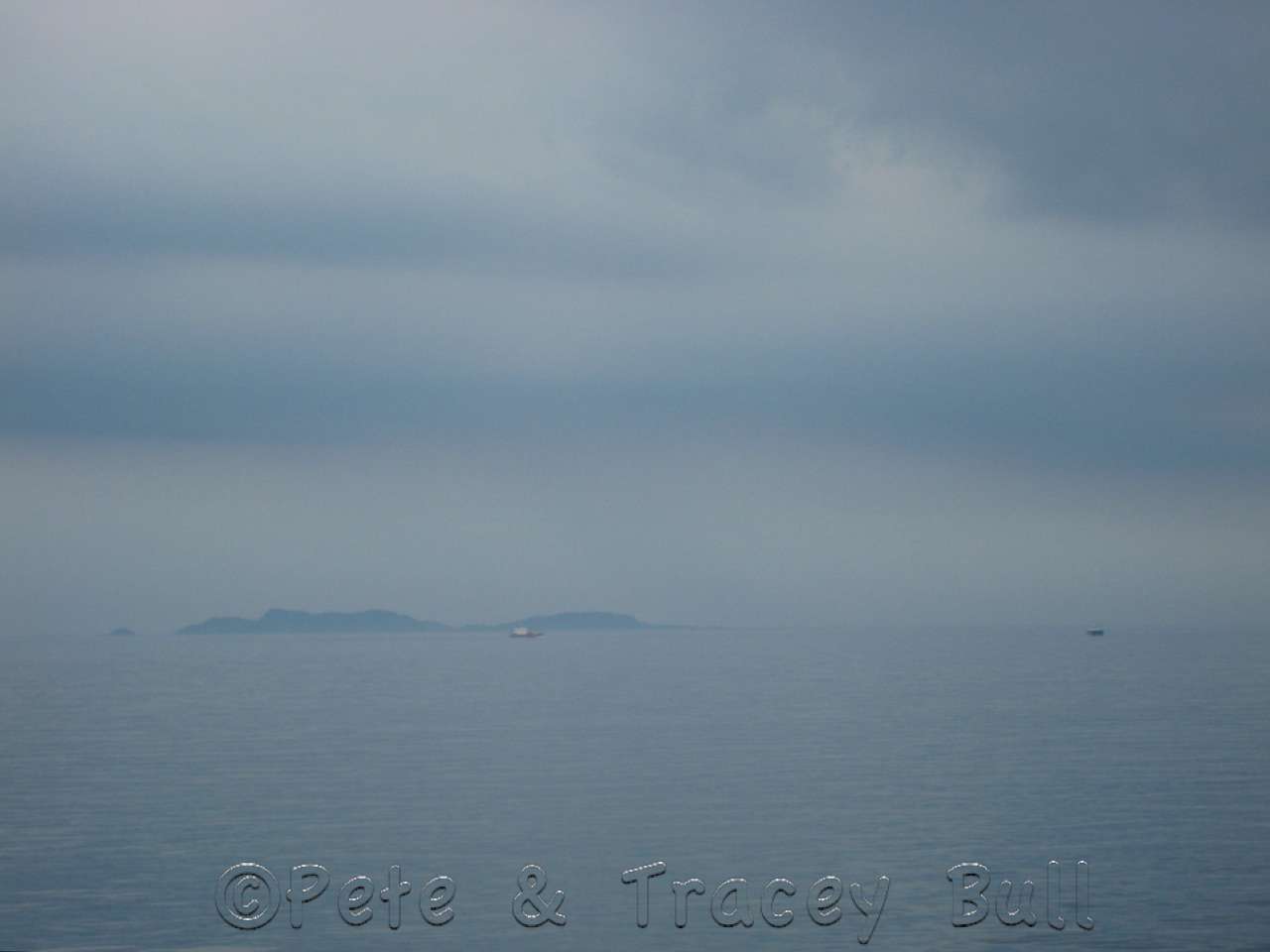
"Had the beach at Horgabost to ourselves, 10pm, still light. Yellow sand, sand hoppers. Grey sand below the yellow, revealed in trickles towards the sea. Bits of shells, white, orange, purple, sparsely scattered near shore. Calm calm calm. Lapping water's edge. Endless blue hues. Yellow showing through shallowest clear sea, graduating into the palest greeny turquoise. To my left a grassy dune casts an emerald reflection. In front of me misty purple mountains, and the sea between me and them layer upon layer of bluey, lilacy, mauvey, hazy greys, blues, purples.
My breathing quiet, my eyes won't turn away. The stillness a priceless gem. Oneness. This is what we hope to attain in contemplation. A blissful state manifest."


T

Sunday, 18 July 2010

Peat Fires and Standing Stones


Ancient history is part of the landscape in the Hebrides. Standing stones, stone circles, dry-stone buildings, they're made from pieces of the landscape and they stand or fall back into it.


Dun Carloway was impressively intact. Often you need some artist's impression to help you to imagine what looks like a pile of stones now may once have been. But here is a large intact section of a massive dry-stone, double-walled structure, beautifully built with the outward facing surfaces almost as smooth as if they had been built from purpose-made bricks. The stones have been so skilfully chosen and placed to have stayed put for over two thousand years, and arranged like an enormous three dimensional jigsaw puzzle.


The black houses which can be seen in good condition at Gearrannan and Arnol were possibly built in the same way for centuries and the village at Gearrannan was inhabited until 1974. These houses were built to withstand the lashing and pelting of the wind and rain. Gales in recent years apparently damaged modern houses while the old black houses stood their ground.


At the village of Arnol there is a preserved black house as well as remains of many more. The preserved black house is now a museum and they keep the peat fire burning at all times. This is not just for an authentic atmosphere, the smoke, which gives the thatched roof the blackened appearance, and hence the name 'black house', helps to keep it dry.


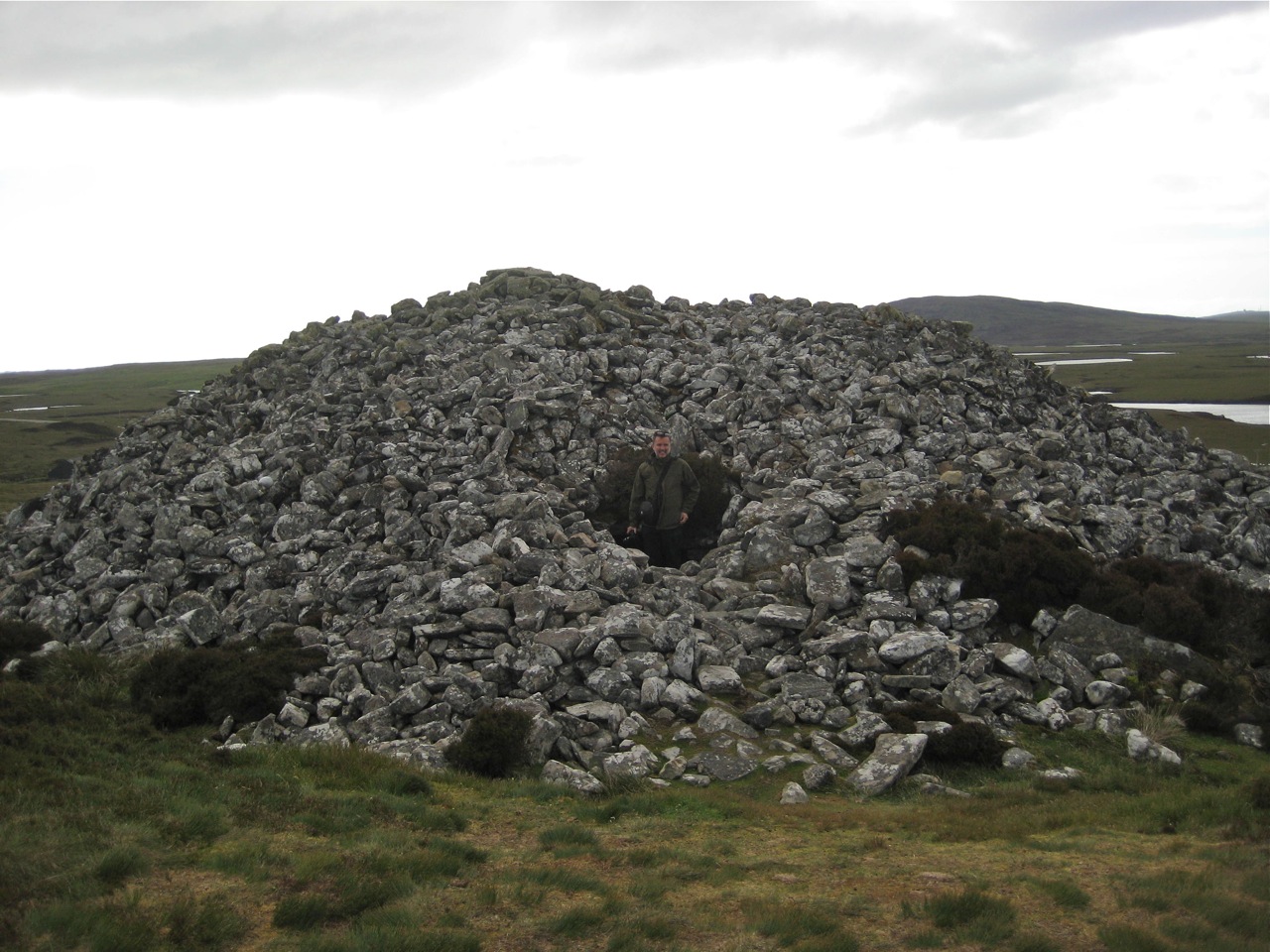
The Callanish Stones on the west side of Lewis is the most awesome arrangement of megalithic standing stones I have seen so far. There are lines of stones leading to a circle and a burial cairn. As usual there are various interpretations (ceremonial, astrological), and it is easy to imagine that the corridors have a kind of processional feel to them.


This monument is more than 4,000 years old and in that time it has probably been appropriated for all sorts of uses. In fact carbon dating has shown that the cairn is a later addition.

These days you may spot a hippy smoking a joint and enjoying the vibes. You will also find it difficult to get a photograph without another photographer in shot. Especially at sunset.

Perhaps the lack of solid facts on something this old is what allows speculation. The imagination can play. The atmosphere and prehistoric other-worldliness can be enjoyed.

By the way, those of you who crave factual detail can find it on Wiki or elsewhere. This is just me saying, I was there. And this was the view from the 'bedroom'.


T

Wednesday, 14 July 2010

The Windiest Place In The UK


Contininuing our journeys to the furthest points on the map and the ends of roads... we took ourselves to The Butt of Lewis lighthouse at the north end of the island. Apparently it has appeared in the Guiness Book of Records for being the windiest place in the UK. To the west there is nothing between it and north America, while the next stop in a northwards direction is the Arctic. So you would expect something wild and windy, with crashing waves. We had a freakishly warm day with clear blue skies and a calm, lapping sea, perfect conditons for this couple to perch on a cliff face and have a picnic.


If you need supplies, this might be the place.


T

Monday, 12 July 2010

On to Harris and Lewis


The journey from Benbecula to the Isles of Lewis and Harris went like this: A drive to Berneray to catch the ferry to Leverburgh. The crew were careful, guiding us on. The issue being the angle between the land side ramp and the ramp on the boat. We had grounded before. We took it slowly. A smiley crewman told us, "That's you on the ferry". I could stop holding my breath.

A hairy journey along twisting single track roads with ditches either side, to a campsite on Harris, misnamed a 'touring park' made us rethink our plan. We headed north to Lewis. A few days in a site with all the facilities near to Stornoway were followed by a move to Siabost (Shawbost) on the west coast, where the site was basically the back garden of a lovely, friendly woman called Mary.


Siabost was a great base from which to explore some extraordinary ancient buildings and monuments on Lewis. You have to squat to get a good look at the wild orchids. These images are from our first visit to the stone circles at Callanish. Since it was grey and wet, we would return on a brighter day.


Friday, 2 July 2010

More Island Memories


As promised, here are some more highlights and images from our three month trip around the Scottish Highlands and Islands last summer. Well, you don't want to hear about our recent preoccupation with an ant invasion, and how we gained an even more intimate knowledge of the innards of our Airstream, do you?

When we returned from Barra to the conjoined islands of the Uists and Benbecula we spent a couple of days driving around them, taking in the strange, loch-pitted landscape. We would do the end-of-the-road thing that we love to do. When you're following the coastline, or on an island, you may as well follow a road to its end. You might find nothing. You might find a great view.

We were so lucky to have sunny weather in which to enjoy the openness of the scenery. With a landscape this flat, surrounded by sea, I bet you can get a right old pelting when the wind picks up. Mind you, makes you feel alive doesn't it?


We took in the monument at Flora MacDonald's birthplace, the statue of Our Lady of the Isles and a whole bunch of drystone ruins. Those old buildings must take hundreds of years to topple, even if you do borrow a few stones to build your new house. Typically, it looks like you build your new house next to your old one, move in and let the old one fade away very, very slowly.


On our second day of exploring we pointed ourselves northwards to North Uist and Berneray. We found a stone circle which had eluded us a few days before. Pobull Fhinn got an enthusiastic write-up in one of our Aubrey Burl books and so we had another look. You can walk from the Barpa Langass chambered cairn, or via a footpath next to the Langass Lodge Hotel.


I know these old stones don't touch everyone but believe me, they are pretty much always in a beautiful spot. Pobull Fhinn overlooks Loch Langass, which glistened on the day we were there, with hills beyond. And anyway, you have to savour and respect something that's probably been there for about four thousand years. And respect to the people of a place who just leave things be for all that time.


Further north we strode across the stepping stones of the causeway to Dun an Sticir, a broch in a loch. Then on to the Balranald RSPB nature reserve where we saw Lapwings, Terns, Oyster Catchers,


and we endured an overpowering stench of rotting seaweed, reminiscent of soiled nappies. Sometimes the sea air palpably fills you with the invisible life force, sometimes it makes you gag.

Here's a view to uplift and to end on a more pleasant note.


T

Thursday, 17 December 2009

Notes From Here And There


We have had an attack of the gremlins lately. There was the wheel falling off, someone drove into us, Pete's laptop went all dark and mysterious. Not letting any of it get us down though. We're keeping warm and dry and staying on top of the 'moisture management'. That's mopping up condensation for all you non-trailer dwellers.

The rain has abated and our view of the Somerset levels which so far looked like a lake has revealed itself to be fields. It is proper cold though, dead wintry.

I spent last weekend in London visiting my bestest friend. We talked for two whole days. Life makes a bit more sense now. Life also makes more sense because I was able to travel by bus from Ilchester to Hammersmith for £20.00 return with a local coach company. Maybe mankind isn't doomed after all.

We are still prolonging our memories of the Hebrides. The idea is that, since we're taking things slow over the winter we could tell about our summer travels when there's not much to report around here.

To that end....


Back in June we took a small ferry from Eriskay to Barra. The Airstream grounded on the way onto the ferry so the crew were ready with the chocks to get us off at the other side. We took it slowly but unfortunately one of the guys put a chock in upside down so that as we drove over it, it tipped up and got caught in the spare wheel carrier underneath. Oh dear, we thought, or more expletive words to that effect. Many heart palpitations and miniscule manoeuvrings later we were free and headed for the beach where Andrew had bagsied us a spot next to him.


Now I would really like to tell you absolutely nothing about Barra because it is beautiful and special and very small, so I don't really want to encourage anyone to go there and make it all busy and stuff, like everywhere else. Have I said it before? probably, that Britain is small and populated areas are close together and there aren't enough empty spaces. Well Barra in June was lovely and empty.

The sky was clear, the sun shone, the sea was the cleanest, crystal-like I have ever seen and there were empty white beaches.


We parked up next to Andrew on the beach. This is really what we had wanted to do since buying the Airstream. Wild camping with a trailer is not permitted in England. On Barra it's the only kind of camping. The airport is a few hundred yards from where you can camp and tiny planes land on the sand a couple of times a day when the tides permit. There is a fresh water tap outside the 'terminal' and a neighbour told us where there were boat docking facilities where we could take our waste.


So that covered all the necessities. We set up, sat and admired the best view ever and waited for our friend Helen to arrive by plane from London. She had a few days off from her busy metropolitan life and the prospect of landing on the beach was the enticement she succumbed to. About five minutes before her plane was due we started strolling along the beach to meet her.


The next few days were a perfect mix of paddling, sitting around Andrew's fire-pit, watching sunsets, a boat-trip to Mingulay to get up close to the puffins, sandcastle building, castle visiting.

The sun went down very late at that time of year. It was light until eleven, eleven-thirty, which is great for nocturnal types like us.

A note on the weather, which was brilliant for those few days even if breezy at times. It can get very wild and windy up there and I suspect those white beaches and turquoise seas might be a little less inviting.


Having said that, our neighbour, Christine, has been going back and staying for two months every year for over a decade. Her caravan was anchored down. She said that when it gets stormy she thinks to herself, never again. And yet there she was. We met quite a few people who go back regularly. We all had big smiles on our faces. You would too, but of course I'm begging you not to go.


T

Wednesday, 2 December 2009

Uig to Uist

Wherever we have been lately it has rained persistently (Cumbria, Dorset, Somerset). Most of the UK is dripping at the moment so it seems like a good time to reminisce about our Hebridean journey and some blue skies. So the following took place back in June.


We had decided to go ahead with our Outer Hebrides trip. We turned up at Uig harbour, got measured to see if they could squeeze us onto a fully booked ferry and made the crossing to North Uist. From the harbour at Lochmaddy we drove south to Benbecula where fellow Airstreamer Andrew was staying and had reserved us a pitch.


Within a week we would be back this way to explore the landscape and bronze age ruins more thoroughly but this time we were basically passing through and just beginning to get a taste of this unique part of the British Isles.

I hope I can do justice to these islands. I suppose I can just start with my first impressions as we headed down to Benbecula. I didn't know what to expect, but I hadn't expected this. It was pretty flat. In my English mind Scotland is hilly. Surely the Western Isles would bear some resemblance?


Hills were usually visible at some point on the horizon but mostly there were wide open spaces. And these adjoining islands are generously dotted with various bodies of water. Or is it that the stretches of land are just giant stepping stones? Roads have somehow been built across peaty bogs, islands have been connected with causeways, watery areas of all sizes from pond to loch to actual sea surround you. There appears to be more water than land. The land has holes in it. It's like a massive peaty doily.


In a nutshell it is open, flat, boggy, lochy, causewayed and spread out. Oh, and no trees. But there is plenty of peat. More about peat later. Bet you can't wait. No wait, it's good stuff. Come back.


Buildings look like they are naturally spaced apart where the land allows. So instead of villages of close-together houses there are settlements where your nearest neighbour might be half a mile away, or more. Except on Benbecula where you come across an airbase and an attached community. Somewhere in there is a supermarket but you would have to be smarter than me or Andrew to find your way into it. We did eventually figure out that the entrance was disguised as a bus shelter, obviously. It probably gets pretty windy around there and you would need a buffer between the outside and inside. A bus shelter fits the bill.

It was worth the sleuthing though because among other lovely things within we found clotted cream to go with the scones we'd already hunted down. And so afternoon tea would be ceremonially enjoyed later that day.

On another day Pete and I returned to Lochmaddy to check out the arts centre. We had a look around an exhibition of photographs by Erskine Beveridge, a textile manufacturer who had been a frequent visitor to the islands in the late nineteenth century. He was interested in the islanders' way of life and captured it in pretty stark and atmospheric black and white images.

There was also an exhibition of sculptures by Claire McNiven. Figures caught in motion were built from tangles of string and rope which the sculptor had found on her walks on the beach. In a long-ago incarnation I was a dancer and seeing these figures really captured and reminded me of the split second moments of off-balance transition between one shape and the next. It was truly lovely and all from bits of reclaimed string.


We had a quiet Sunday on Benbecula which included a walk on the adjacent beach. The sand was white, the sky blue with voluptuous clouds hovering on the horizon. The sea was pure turquoise. There were tidemarks of small shells, crab shells, seaweed. There was even the jaw bone of a sheep. Since there is water everywhere, anything can eventually get washed out to sea.

The sunlight, the shades of blue and the reflectiveness of the white sand are incredibly uplifting. And there was plenty more of that to come.


T

Thursday, 22 October 2009

Reaching Skye


Now that Autumn is firmly upon us, it’s good to look back on those gloriously long, hot days of the early Summer.

The first stop on Skye was at the Glenbrittle campsite, a charming little spot, tucked away at the end of an eight-mile cul-de-sac. It’s designed for tenters who fancy a crack at the very enticing Cuilin Ridge. The road to the site was a tricksy little thing, with a steep drop into the valley with two miles to go. We stopped to let the over-run brakes cool down (and to admire our Airstream in the wild).


The site itself was one of those “park-where-you-like” jobbies, with only a handful of hard standings with hook-ups. We found a spot on the grass with a view out to sea, and spent a few days running on solar power. And there was plenty of it.

It’s perhaps worth mentioning our batteries. Back at Easter, we spent five days on a site without hook-up. It was my own silly mistake, but when I booked us onto a Camping and Caravanning Club site, I completely failed to register that a Standard Pitch can mean nothing more than a patch of grass. For the Caravan Club on the other hand, a Standard Pitch might include a hard standing, electric hook-up, breakfast in bed and the grass cut four times a day. So we tried to live off the batteries. The days were bright and sunny, but being early April, they weren’t very long, so to spare the blushes of the solar panel on the roof, we used the site shower and toilet facilities. You’d think that by watching minimum TV, using only LED lights and not running any fans, we should be able to last quite a while. On the third evening, the voltage dropped so low that the inverter wouldn’t run, so we had to go to bed at nine o’clock! I haven’t done that since I was a tiddler! The next couple of days were taken up by waiting around in the mornings until we were allowed to run the generator for a couple of hours, leaving us about an hour to explore before everything shut. So, these two 90 Amp-hour batteries were lasting next to no time. On our next trip to Tebay, we had an exchange of views on the state of the batteries. It turns out that the batteries are not covered by the warranty which, to be honest, is fair enough, but I wasn’t best chuffed to have to fork out around three hundred quid on something that was less than 18 months old. Airstream did, however, replace the PSU in case there was a fault with the charging system. The old one was sent off for testing – I’m still waiting for the results…

So, with new batteries and glorious sunshine, we had no problems surviving on Skye. Being at the end of an inhospitable road, we didn’t venture too far from the site. The Cuilins were calling, but the call fell on deaf ears (I was a: pretty unfit and b: it would have meant getting up early), so we just had a couple of short walks from the site, though one afternoon we did venture as far as the local distillery.


Talisker is a bit rough for my taste, but the tour was interesting. To be honest, though, once you’ve had one distillery tour, you’ve seen them all.

Still not having any plans, we moved on to the Camping and Caravanning Club site at Loch Greshornish. This was a world away from the terrible time we’d had at Easter – the welcome was warm and we were feeling very bold with our new batteries, so we booked in for three nights on a “Standard” pitch. This one came with glorious views across the little sea loch.


In the nearby village of Dunvegan sits the tiny little “Giant Angus MacAskill Museum.”
This was, quite simply, the best entertainment I’ve had this century. It’s a couple of quid to get in. You might need to ring the bell – the curator was in the house next door peeling tatties for when his wife got home from work. This curator, Peter MacAskill, traced his family tree and found he was a distant cousin of the Giant, so he thought it would be a good idea to make a museum of the Giant’s life. Angus, it turns out, never set foot on Skye, and none of the exhibits are original, but the recreations are excellent, and the commentary from Peter (when he wasn’t running off to check the tatties) was eye-wateringly funny.


If you ever visit, you could see the exhibits (housed in the single room of the old smithy) in about ten minutes, but allow yourselves at least three quarters of an hour for the stories. And don’t leave without asking about the coffin… The picture shows a waxwork of Angus, one of General Tom Thumb (who was in the same Show Business as Angus) and the real Peter MacAskill - Curator and Comedian.

It was while we were sitting in the campsite one afternoon that we decided that we would just hang the expense and go to the Hebrides anyway. You may remember that we have mentioned CalMac Ferries arbitrary pricing structure. Caravans are only supposed to be up to 8 metres long – anything longer gets charged as a commercial vehicle. They take 10 metre motor homes, but not 8.25m caravans, like our 684. Back in Oban (which was about the last time we were to get mobile internet access for the next three months!), I got on my high horse and send some frank emails to various people. It seems that the Hebridean Tourist Development Agency were familiar with CalMac’s fun and games, and the Scottish Minister for Transport promised to bring it up at the next meeting with the CalMac board. Caledonian MacBrayne, by the way, is wholly owned and funded by the Scottish Government, so you know who to complain to…

So we turned up at the ferry port in Uig, got a ticket and found ourselves, at least for the time being, leaving Skye and on the way to the Outer Hebrides…